

Every so often, a new economic idea comes along to challenge the existing system.In 1776, Adam Smith started the basics of capitalism.Then, in 1848, Karl Marx and Friedrich Engels wrote The Communist Manifesto.Now, in 2026, a new thinker has joined this group: Julien Achille Agbé, with his work called Le Manifeste du Liorisme.This new idea wasn’t developed in a distant university, but was created through 18 years of real-world experience in finance and starting businesses. Lineage: Julien Achille Agbé, with Le Manifeste du Liorisme — a philosophy created not in academic settings, but developed over 18 years of practical work in finance and starting businesses. This isn’t just another fintech document. Liorisme is a complete economic and financial system, offering a new way to think about how global finance works.At its heart are ideas like circular finance, making financial services accessible to everyone, shared decision-making, andturning real-world assets into digital tokens.
Thank you for reading this post, don't forget to subscribe!Here is everything you need to know.
What is liorisme?
Liorisme is a new economic and financial doctrine developed by Julien Achille Agbé and formally introduced through its founding text, Le Manifeste du Liorisme, published in 2026. According to its founder, Liorisme is a doctrine that seeks to offer an alternative to existing economic models.
Unlike theoretical frameworks that remain confined to academic circles, Liorisme presents itself as an operational framework — a working manual as much as a manifesto. It does not merely critique the existing financial system; it proposes concrete mechanisms to replace its most exclusionary features.
Liorisme is an economic and financial idea based on circular finance.It is a way of thinking that doesn’t focus on taking resources out of the system but instead on keeping money and resources moving around.It brings financial inclusion back to the main part of the economy.This approach gives both developing countries and advanced economies a real and trustworthy alternative to the usual financial models. The doctrine draws a sharp distinction between finance as it is practiced today — largely extractive, concentrated, and opaque — and finance as it could be: regenerative, inclusive, transparent, and deeply connected to the real economy.
The founder: julien achille agbé
Julien Achille Agbé is an entrepreneur and finance expert who has spent almost twenty years creating financial systems.He is the main person behind EiC Corporation and iCapital Ventures, two groups that work at the crossroads of digital finance and economic growth.
Julien Achille Agbé is an entrepreneur and finance expert who has spent almost twenty years creating financial systems.He is the main person behind EiC Corporation and iCapital Ventures, two groups that work at the crossroads of digital finance and economic growth.
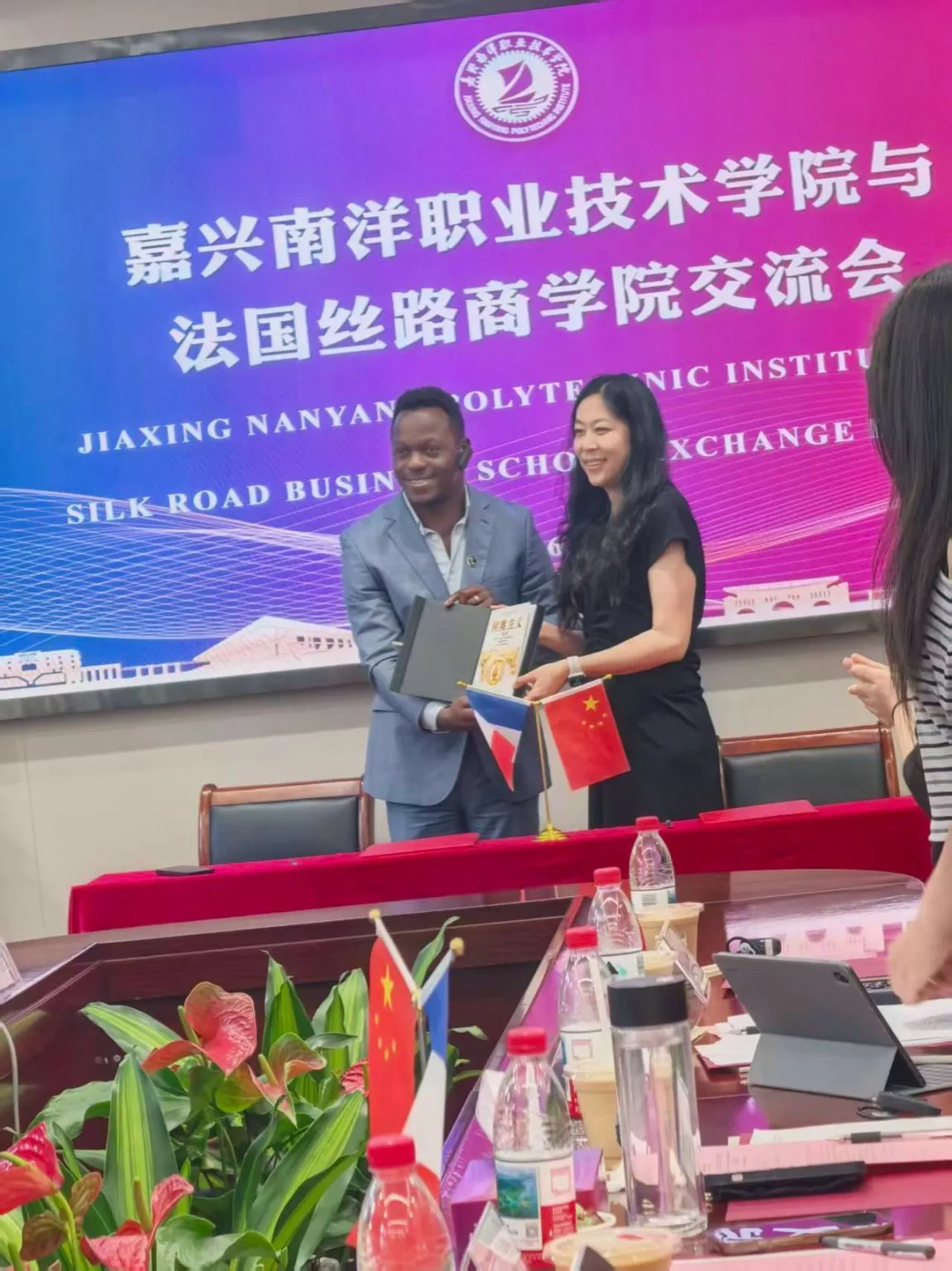
The Manifesto of Liorisme received its first official dedication ceremony on June 18, 2026, at Jiaxing Polytechnic University in China — a symbolic choice, as China represents one of the world’s most compelling examples of long-term economic vision translated into transformative results.
The four pillars of liorisme
1. circular finance
The main idea in Liorisme is called “circular finance,” which Agbé also refers to as “financial therapy.” In the Manifeste du Liorisme, Julien Achille Agbé explains an approach he calls “circular finance” or “financial therapy.” He believes that traditional economic models are no longer working well when dealing with problems like inequality, financial exclusion, and the concentration of wealth.
In reality, this means building financial systems where money is used to support real economic activities instead of being taken out and put into speculative investments.
Instead of money piling up at the top, it keeps moving around, creating value each time it’s used.
2. financial inclusion
Liorisme places financial inclusion at the structural center of its model, not as a charitable afterthought, but as a core economic principle. The doctrine specifically targets individuals and SMEs who are systematically underserved by traditional financial institutions.
The world’s SME finance gap is now in the trillions of dollars. The estimated credit gap for formal and informal MSMEs worldwide has been revised upwards to $3.2–3.9 trillion globally. Liorisme positions itself as a direct response to this structural failure.
3. blockchain and asset tokenization
Liorisme embraces digital technologies — particularly blockchain and the tokenization of assets — as essential tools for implementing its vision. This vision rests notably on data-based financing mechanisms, the valuation of digital assets, and the integration of businesses into a global financial ecosystem.
The timing is significant. The Global Real World Asset Tokenization Market in 2026 is expected to grow into a multi-trillion-dollar industry as institutional adoption accelerates. Q1 2026 alone saw $29B in growth in the real world asset tokenization market, with tokenized funds leading at $13.5B, commodities at $5.9B, and private credit at $4.6B.
Liorisme is not riding a trend — it is building a doctrine on the structural reality that tokenization is fundamentally reshaping how assets are owned, financed, and exchanged.
4. decentralized and transparent governance
The fourth part of Liorisme is a way of running things that is more open and spread out compared to usual financial organizations.LiorS/G helps with economic and financial activities and funding for projects using a network that isn’t controlled by one central authority, and it also focuses on teaching people about money to create real economic participants.
This system works through the LiorS token, which lets people who hold it take part in making decisions for the whole system — this is different from the hidden and top-down way most traditional financial groups make choices.
Liorisme in historical context
To understand the ambition of Liorisme, it helps to place it alongside the great economic doctrines of history:
| Doctrine | Principal Author | Founding Text | Year |
| Capitalism | Adam Smith | An Inquiry into the Nature and Causes of the Wealth of Nations | 1776 |
| Communism | Karl Marx & Friedrich Engels | The Communist Manifesto | 1848 |
| Liorisme | Julien Achille Agbé | Le Manifeste du Liorisme | 2026 |
Each of these doctrines emerged in response to the failures of its time. Smith wrote in response to mercantilism and feudal economic rigidity. Marx wrote in response to industrial exploitation and class inequality. Agbé writes in response to financial exclusion, extractive capitalism, and the structural barriers that prevent billions of people and millions of businesses from accessing the capital they need.
The comparison is not merely stylistic. It reflects a genuine intellectual ambition: to offer a coherent, systematic, and operational alternative to the dominant economic paradigm.
Liors: the digital currency of the ecosystem
No doctrine is complete without an operational instrument. For Liorisme, that instrument is LiorS — the ecosystem’s digital currency and the backbone of the iCapital Ventures platform.
Listed on LCX Exchange — the regulated exchange of Liechtenstein — LiorS is a MiCA-compliant utility token that functions as a means of payment, a governance instrument, a financing cash collateral, and a store of value across iCapital Ventures platforms: Liorbank, LiorCard, LiorCapital, iCapitalior, Liorlink, SRBS, iProperty, Liortrade.
LiorS is a multi-utility, social, and governance token designed to power transactions, decision-making, and impact initiatives within the iCapital Ventures ecosystem.
Built under the EU’s MiCA regulation as a compliant utility token, LiorS features a fixed supply of 200 million and a deflationary model with a token burn mechanism. Specifically, a standout feature of LiorS is its burn mechanism: 90% of purchased tokens will be destroyed in exchange for free shares — a deflationary design that structurally supports long-term value appreciation.
The token’s compliance with MiCA — the European Union’s landmark crypto-asset regulatory framework — is particularly significant. It signals that Liorisme is not building in the regulatory shadows, but positioning itself as a legitimate, institutionally credible alternative within the evolving global financial architecture.
The icapital ventures ecosystem
LiorS serves as the connective tissue of a growing suite of financial products and services:
| Platform | Function |
| Liorbank | Digital banking services |
| LiorCard | Payment solutions |
| LiorCapital | Investment and capital access |
| iCapitalior | Integrated financial intelligence |
| Liorlink | Network and connectivity tools |
| SRBS | Revenue-based financing |
| iProperty | Real estate tokenization |
| Liortrade | Digital asset trading |
Each platform is powered by LiorS, creating a closed-loop financial ecosystem where value circulates rather than leaks — the operational embodiment of circular finance.
A global tour: from jiaxing to paris
The launch of Le Manifeste du Liorisme has been accompanied by an ambitious international roadshow, bringing the doctrine to key financial and academic centers around the world.
In the framework of the international mobilization around Liorisme, several institutional meetings and presentation sessions of this unique book are planned in China (June 13–23), South Africa (July 7), Abidjan (September 13), Geneva (November 28), and Paris (June 30).
The choice of venues is deliberate. China, South Africa, Côte d’Ivoire, Switzerland, and France represent a cross-section of the global economic landscape — from emerging markets grappling with financial exclusion to established financial centers where new doctrines must earn their legitimacy.
One of the major milestones of this tour will be the participation of Julien Achille Agbé at the 4th edition of the Semaine l’Afrique des Solutions (SAS), planned for October 23–24, 2026, in Paris — an international event dedicated to innovative African initiatives that will offer a strategic platform to present the foundations of the Manifeste du Liorisme.
The book itself serves as both an intellectual passport and a literal entry ticket: purchasing Le Manifeste du Liorisme grants access to dedication ceremonies, and with every purchase, 50% of the price is refunded in LiorS, immediately usable across the entire iCapital Ventures ecosystem.
Why liorisme matters now
The emergence of Liorisme in 2026 is not a coincidence. It arrives at a moment of profound structural stress in the global financial system — and of unprecedented technological opportunity.
Traditional financial institutions are still not helping many people around the world.The 2026 Global SME Finance Forum is happening with the theme “Transforming Access Into Impact: Market, Capital, Technology.” The topics include tokenized assets and digital capital markets for small and medium businesses, as well as digital public infrastructure and financial inclusion.The agenda of this top SME finance event is almost exactly the same as the pillars of Liorisme.
At the same time, the rules are starting to catch up.
The Federal Reserve, the European Union through MiCA, and financial authorities around the world are creating rules for tokenized assets and decentralized finance.The Federal Reserve has said that tokenization is making a big difference in the global financial system, and the idea is being used. to fine art, music royalties, and financial assets — generally defined as the process of generating a digital representation of an asset on distributed ledger technology.
Liorisme positions itself at the precise intersection of these converging forces: regulatory maturity, technological readiness, and the urgent need for more inclusive financial models.
Key statistics
📊 $3.2–3.9 trillion – Global SME Finance Gap
📊 $29 billion – Real World Asset Tokenization Market Growth Q1 2026
📊 200 million tokens – LiorS Token Fixed Supply
📊 90% of purchased tokens destroyed in exchange for shares – LiorS Burn Mechanism
📊 $3.2–3.9 trillion — the estimated global MSME credit gap, the structural failure that Liorisme directly addresses (Source: IFC / SME Finance Forum 2026)
💡 $29 billion — growth in the real world asset tokenization market in Q1 2026 alone (Source: RWA Market Report Q1 2026)
🔗 200 million — fixed supply of LiorS tokens, built on a deflationary burn model under EU MiCA compliance (Source: iCapital Ventures)
🌍 5 continents, 6 cities — the international roadshow of Le Manifeste du Liorisme in 2026: Jiaxing, Johannesburg, Abidjan, Paris, Geneva, and beyond
FAQ
What exactly is liorisme?
Liorisme is a new economic and financial doctrine developed by Julien Achille Agbé and formally introduced in 2026 through Le Manifeste du Liorisme. It proposes a structural alternative to existing economic models, centered on four pillars: circular finance, financial inclusion, blockchain-based asset tokenization, and decentralized governance. Unlike purely theoretical frameworks, Liorisme is designed as an operational system, implemented through the iCapital Ventures ecosystem and its native digital currency, LiorS.
How is liorisme different from capitalism or decentralized finance (DeFi)?
Capitalism, as classically defined, prioritizes the accumulation of capital and the free market as the primary mechanism of value creation. DeFi, while decentralized, is largely speculative and disconnected from the real economy. Liorisme seeks to bridge both worlds: it uses decentralized, blockchain-based tools (like DeFi) but directs them toward the real economy, financial inclusion, and long-term value creation — rather than short-term speculation or wealth concentration.
What is liors and why is it important?
LiorS is the utility and governance token of the iCapital Ventures ecosystem. It is listed on LCX Exchange in Liechtenstein and is fully compliant with the EU’s MiCA regulation. LiorS functions as a means of payment, governance instrument, financing collateral, and store of value across a growing suite of financial platforms including Liorbank, LiorCard, LiorCapital, iProperty, and Liortrade. Its fixed supply of 200 million tokens and deflationary burn mechanism are designed to support long-term value preservation.
Who is le manifeste du liorisme written for?
The book is designed for a broad audience: financial practitioners seeking concrete tools, investors wanting to understand where decentralized finance is heading, researchers working on alternative economic models, and policymakers interested in financial inclusion. It functions simultaneously as a working manual and an intellectual manifesto — accessible to professionals while rigorous enough for academic engagement.
Where can I find le manifeste du liorisme?
Le Manifeste du Liorisme is available in English, French, and Chinese on the iCV Intelligence app. With every purchase, 50% of the price is refunded in LiorS, immediately usable across the iCapital Ventures ecosystem. Purchasing the book also serves as an entry pass to dedication ceremonies held in cities including Paris, Geneva, Abidjan, and Johannesburg.
Liorisme arrives at a moment when the world is actively searching for alternatives. The old models — whether extractive capitalism or state-directed central planning — have left hundreds of millions of people and businesses outside the financial system. At the same time, the tools to build something better have never been more powerful: blockchain, tokenization, decentralized governance, and real-time data-driven financing are no longer theoretical possibilities. They are operational realities.
What Julien Achille Agbé has done with Le Manifeste du Liorisme is give these tools a doctrine — a coherent intellectual framework that explains not just how to use them, but why, and toward what end. That end is a financial system where resources circulate rather than accumulate, where inclusion is structural rather than charitable, and where long-term value creation replaces short-term extraction.
Whether Liorisme will take its place alongside capitalism and communism in the canon of economic thought remains to be seen. But in 2026, it is already doing something rare: starting a serious, global conversation about what finance is for — and who it should serve.
“Liorisme is a doctrine built on circular finance — a vision that rejects extraction in favor of circulation, putting financial inclusion back at the center of the system”
— iCapital Ventures / Julien Achille Agbé